When looking at an engagement ring or a pair of sparkling stud earrings, you may ask yourself: what is the difference between diamonds and brilliants? In everyday life, the two terms are often confused or used synonymously, but they do not describe the same thing. The difference is important – not only in terms of appearance, but also in terms of price and value of diamond jewellery.
Diamond: the precious stone
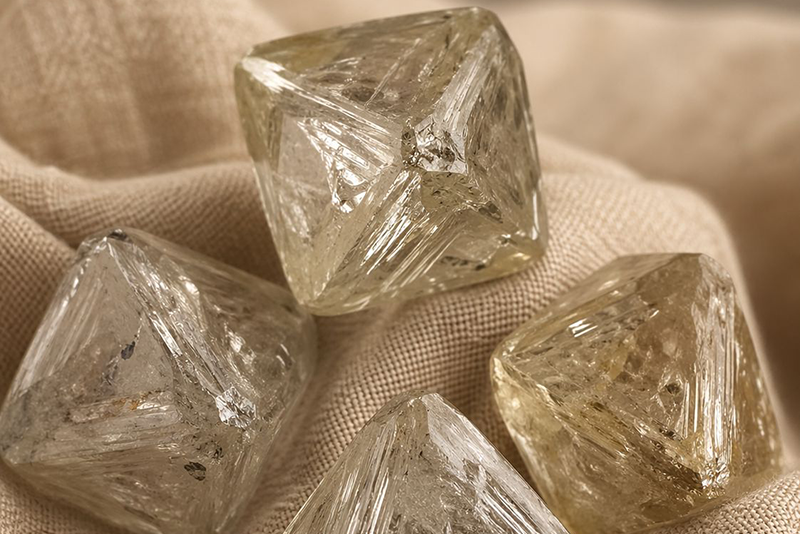
First and foremost, diamonds are a natural product: crystallised carbon that was formed deep within the earth under enormous pressure and intense heat. They are the hardest naturally occurring material and have an exceptionally high refractive index – which is precisely why they look so brilliant and radiant when set in jewellery.
The term “diamond” can mean different things though: the uncut raw crystal, a cut diamond in any shape, or a diamond set in a piece of jewellery. What all these variants have in common is that they are the same gemstone – regardless of whether it is round, square, historically or modern cut.
In short: The term “diamond” refers to the material, not the shape of the cut!
Brilliant: a specifically cut diamond
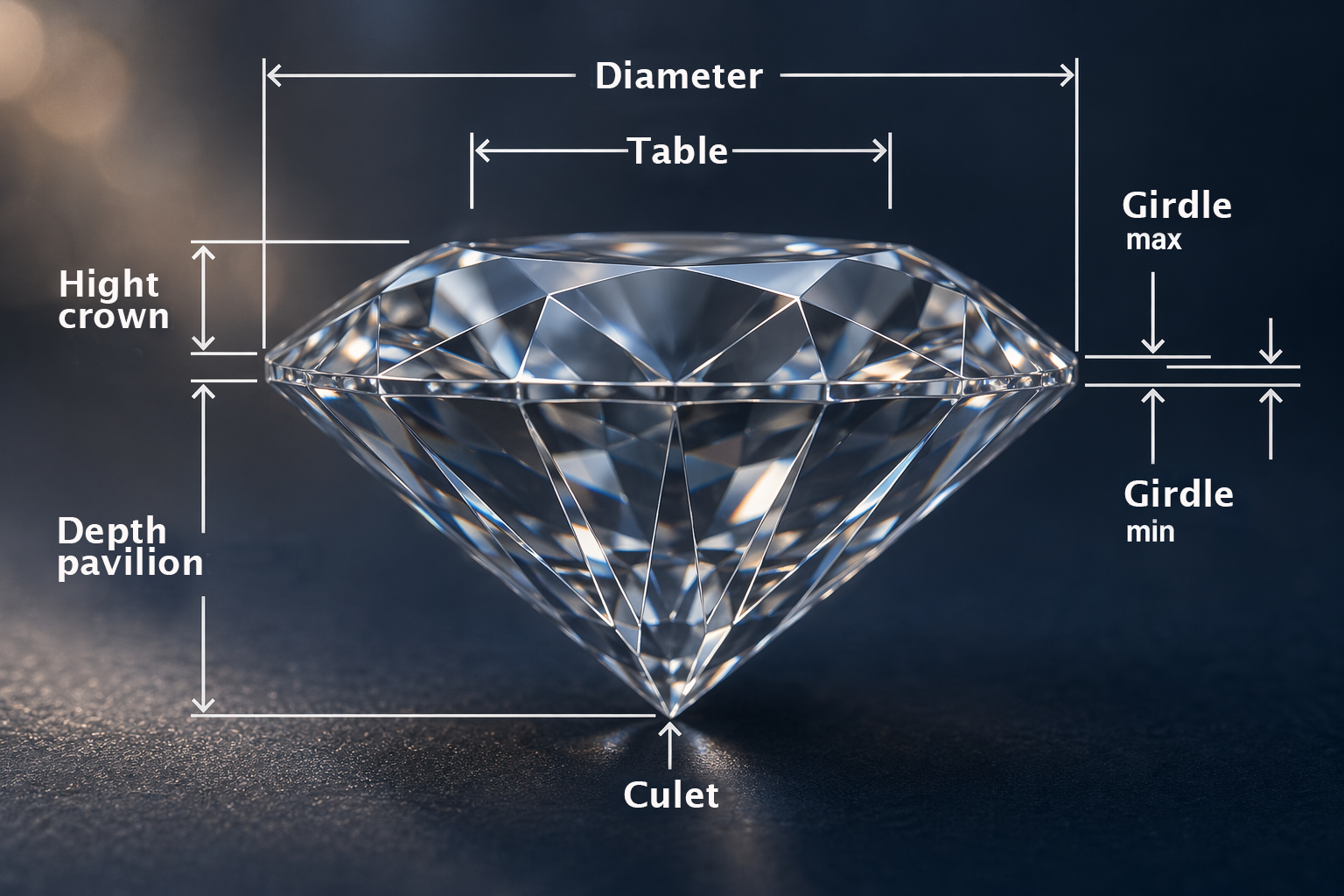
A brilliant is not a gemstone in its own right, but rather a diamond with a specific cut, known as the brilliant cut. This cut was developed at the beginning of the 20th century to refract and reflect incoming light in such a way that the stone ‘absorbs’ as little of it as possible, but instead reflects it back to the maximum extent and refracts it into its spectral colours (brilliance and dispersion). This is how a diamond gets its famous fire.
Typical characteristics of a brilliant-cut diamond are:
• an almost circular contour
• 57 facets (possibly 58 with culet in the pavilion)
In technical terminology, only a diamond with a brilliant cut may be referred to as a brilliant. A ruby or sapphire with the same cut is correctly referred to as a brilliant-cut ruby or sapphire.
So every brilliant is a diamond – but not every diamond is a brilliant!
Historical background: from the Old European Cut to the ideal brilliant
The history of diamond cutting is closely linked to the history of jewellery. For a long time, diamonds were only roughly polished or given a few facets. It was not until modern times that cutters developed increasingly sophisticated shapes to enhance the light effect of the rough stone.
The year 1919 marked a turning point: mathematician and gemmologist Marcel Tolkowsky published his calculations for the ‘ideal’ brilliant cut with precisely defined proportions. The aim was to achieve the best possible combination of brilliance (total reflection of light) and dispersion (colourful flashes of light, fire).
For lovers of antique jewellery, the predecessor forms of the brilliant cut are particularly appealing: the Mazarin or Peruzzi cut and the later Old European Cut often have interesting, irregular proportions and facet sizes, which allow them to capture and reflect the incident light in a softer and more atmospheric way – especially in candlelight, historical diamond jewellery unfolds its very own magic.
Quality criteria: The 4Cs apply to both diamonds and brilliants
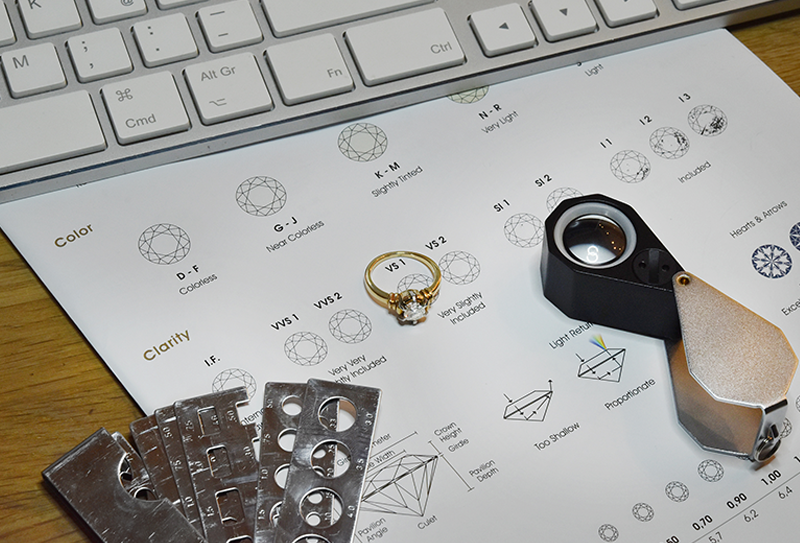
Whether you choose a historical cut or a modern brilliant cut – both are evaluated according to the same four main criteria, the 4Cs:
• Carat – the weight of the stone in carats
• Colour – from colourless to noticeably tinted stones
• Clarity – internal and external characteristics such as inclusions or surface features
• Cut – proportions, symmetry and polish
The cut is particularly important when it comes to any diamond. A carefully proportioned, well-cut diamond appears much more vibrant than a larger but poorly cut stone.
Experts therefore often advise that, if you have a limited budget, it is better to save on the carat weight or, to a lesser extent, the colour, rather than the cut.
Authenticity and designations: How to recognise genuine diamonds
The term brilliant is clearly defined in reputable specialist shops. There are a few points to bear in mind when purchasing brilliant-cut diamonds or other diamond jewellery:
• A brilliant is a diamond with a brilliant cut. Imitations must be clearly labelled as such.
• Particularly high-quality individual stones, especially in rings or solitaire pendants, are often offered with a certificate from renowned laboratories such as GIA or IGI.
• Precious metal hallmarks (e.g. 585 or 750 for gold) provide information about the alloy of the metal, not about the stone. However, they can help to classify the overall quality of the piece of jewellery.
In the case of inherited pieces or flea market finds, it is advisable to have them assessed by an expert. They can check whether diamonds are actually set, what cut they have and how the piece can be classified in terms of era and quality. We are happy to assist you with our expertise as appraisers!
The most important facts in brief
The difference between a diamond and a brilliant-cut diamond lies not in the gemstone itself, but in its cut: a diamond is the mineral itself, while a brilliant-cut diamond is a diamond with a (clearly defined) brilliant cut with at least 57 facets.
Whether you opt for modern diamond jewellery with lively, sparkling brilliants or want to buy antique jewellery full of character, ultimately it is you who decides what you like best.