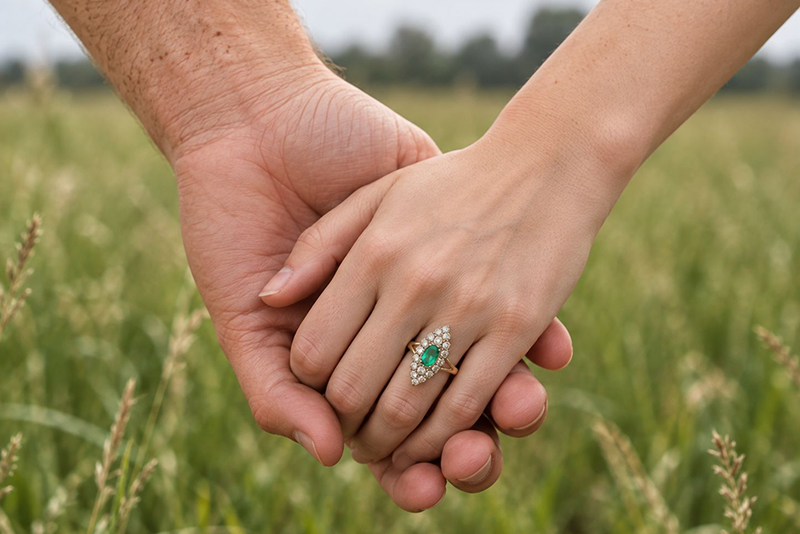
An engagement ring is an everyday companion, a memento, an embodiment of emotion and a promise of love, all rolled into one. No wonder, then, that choosing the right one should be a carefully considered decision. That said, engagement rings today no longer need to conform to any particular ideal.
In our guide, we’ll keep you up to date with the latest trends, whilst also taking a look at the key basics when it comes to diamonds for engagement rings.
From classic to one-of-a-kind pieces – choosing individuality rather than a uniform look
In 1947, an advertising campaign by De Beers, the world’s largest diamond company, succeeded in making the diamond ring the ultimate symbol of everlasting, romantic love, thereby creating a deliberate cultural narrative around engagement rings that was only challenged again in the 21st century.
For decades, the solitaire diamond ring was considered indispensable for a marriage proposal. Even the number of months’ salary to be spent on it was publicly discussed and agreed upon.
Today, these strict guidelines are once again blurring, leaving room for individuality. Social media, in particular, is changing the way we choose engagement rings and appears to be fuelling a new, collective desire for rings that do not look exactly like everyone else’s.
Antique and vintage engagement rings, diamonds in historic cuts and unique material details demonstrate a more personal approach to the engagement ring, which in this way weaves together two narratives: its own past and the story of the couple who will wear it.
Styles with character – which engagement ring suits me?
As well as personal taste, hand shape and everyday life play an important role. After all, a ring intended to be worn every day must not only look beautiful, but also feel comfortable and be durable.
A comparison of timeless designs: solitaire, navette, trilogy, Toi et Moi and halo
The solitaire diamond engagement ring has a timeless and classic look, as a single diamond forms the centrepiece of the design. As early as 1886, the New York jeweller Charles Lewis Tiffany created an iconic reinterpretation of the solitaire ring, setting the diamond in a high prong setting that made it appear to float above the band.
Designs of this kind can usually be combined very well with a wedding band later on, which makes them particularly versatile. On smaller or slender hands, models with delicate proportions look particularly harmonious.
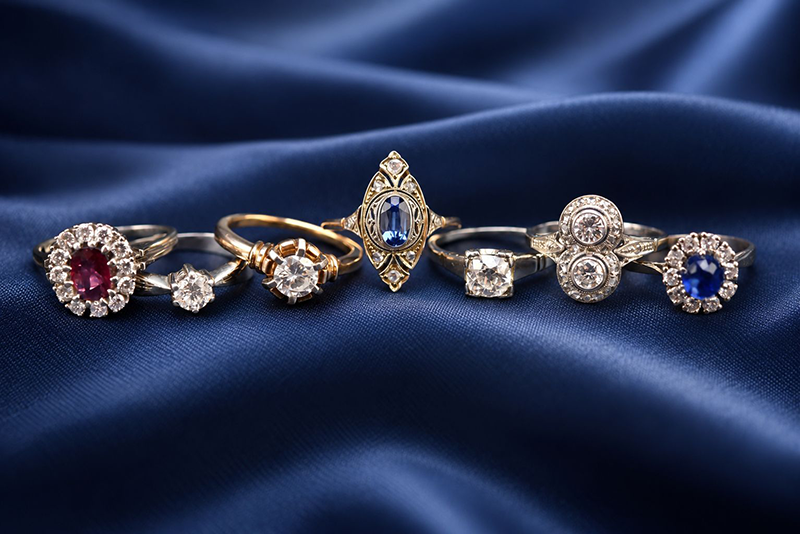
As their name suggests, trilogy rings are always set with three gemstones, which symbolise the past, present and future of the couple in question. The east-west orientation of this design flatters almost any hand and also allows for a certain degree of stylistic freedom. For example, you can choose rings with a larger or coloured centre stone.
Vintage engagement rings in a navette or marquise shape have a visually elongating effect due to their elongated silhouette. They can therefore look particularly elegant on shorter fingers and draw stylistic inspiration from classical jewellery, when diamond rings were first crafted in such a pointed oval shape.
The Toi-et-Moi ring (‘you and me’) features two central stones – traditionally symbolising two people united. Particularly appealing are combinations of two different diamond cuts, or of a diamond and a coloured gemstone, or a diamond and a pearl. Its asymmetrical design makes it an interesting alternative to a traditional engagement ring.
In so-called halo rings, the centre stone is surrounded by a wreath of smaller diamonds, much like a halo. This creates a particularly sparkling composition and can make the central stone appear larger. Entourage rings adopt a similar design principle, but often combine it with coloured gemstones at the centre. A design that enjoyed its heyday, if not before, then certainly with Lady Diana’s famous engagement ring in the 1980s.
The effect of diamonds
Not all diamonds are the same. Different cuts and qualities create different appearances and make every stone a unique piece. We explain what you should bear in mind for your engagement ring below.
Perfected proportions: the brilliant cut
In recent decades, there has seemed to be just one preferred cut for engagement diamonds: the brilliant cut. Since its development in 1919, it has been regarded as the pinnacle of the art of cutting and has been continuously perfected in terms of light yield, brilliance and fire.
If a brilliant-cut diamond is well cut, its 57 facets create a veritable fireworks display of light, ensuring an even, lively sparkle under a wide variety of light sources – from office lighting to dinner in a restaurant.
The turnaround: romantic sparkle with historic cuts
What has been observable for some time, however, is a collective shift away from the perfect brilliant-cut diamond. Not least since the market launch of lab-grown diamonds, diamonds have undergone a change in image: the mineral that once stood for exclusivity became a mass-produced commodity and, as a result, lost its appeal for many.
What followed was a shift towards the unique and individual in the form of antique, natural diamonds with historic cuts. Today, ‘imperfect’ stones that stand out for their character and distinctiveness are often sought after!
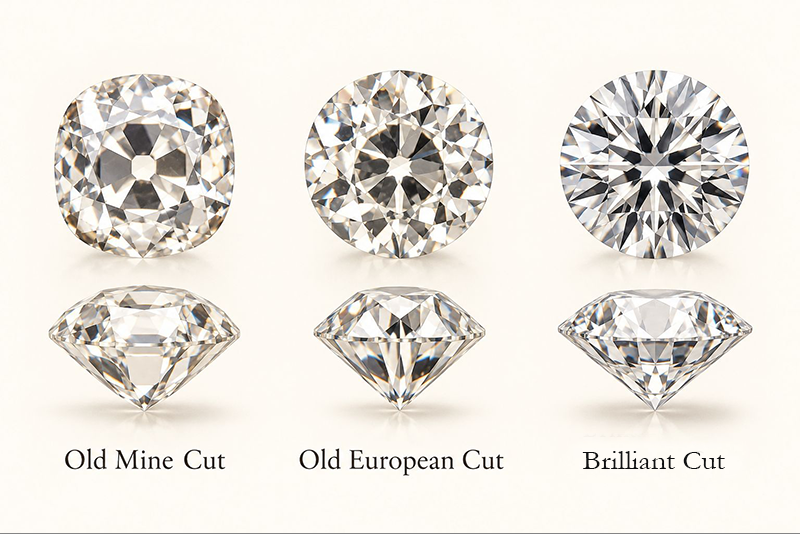
Old Mine Cut and antique cuts
When it comes to weddings, authentic antique jewellery seems to be enjoying a real revival at the moment. Diamond rings from past centuries are particularly sought after, as they showcase historical precursors to the brilliant cut: on the one hand, the Old Mine Cut – a cushion-shaped cut with fewer facets, a high crown and a flat culet – and, on the other, the further development of the Old Mine Cut, the Old European Cut. This is characterised by a higher number of facets, a round basic shape with a smaller table and a similarly flattened culet.
Both cuts originated at a time when diamonds were cut exclusively by hand. As a result, proportions and symmetry can vary considerably; the play of light in these stones therefore often appears calmer and softer, with a romantic sparkle rather than a glaring brilliance. This is hardly surprising, as historical cuts were largely designed for candlelight.
A historical diamond therefore does not strive for mathematical uniformity or even perfection. Minor irregularities are part of its individual character and are once again appreciated today, rather than being perceived as flaws.
Important: Modern grading criteria (the 4Cs) cannot be readily applied to historical cuts, as these were cut according to different principles and under different technical conditions!
A sensible approach to the 4Cs
Please bear in mind that modern evaluation criteria – carat, colour, clarity and cut (the 4Cs) – cannot simply be applied to historical cuts, as these were cut according to different principles and under different technical conditions!
So if you’re looking for an antique engagement ring, you should avoid being too strict with your expectations. You can read about what you should bear in mind when buying diamond jewellery in our article "Buying diamond jewellery: What you really need to look out for".
Important: Inclusions are only just visible to the naked eye from a quality grade of SI upwards.
The right setting – ergonomics and suitability for everyday wear
Particularly in the case of a diamond engagement ring, the stone setting should also be chosen with care. After all, hardly any other piece of jewellery is worn as regularly.
A classic Tiffany-style prong setting allows plenty of light to reach the diamond and showcases it to great effect. At the same time, care should be taken to ensure that the prongs are sturdy, do not have sharp edges and do not protrude unnecessarily far.
A diamond is more securely set in a bezel setting, where the stone is completely enclosed at the level of the girdle. This is an interesting choice for people with an active lifestyle, as this setting protects the gem and prevents it from catching on clothing.
In the case of antique rings, the following also applies: whilst a historic setting may have character, it should be professionally checked for stability before being worn on a daily basis.
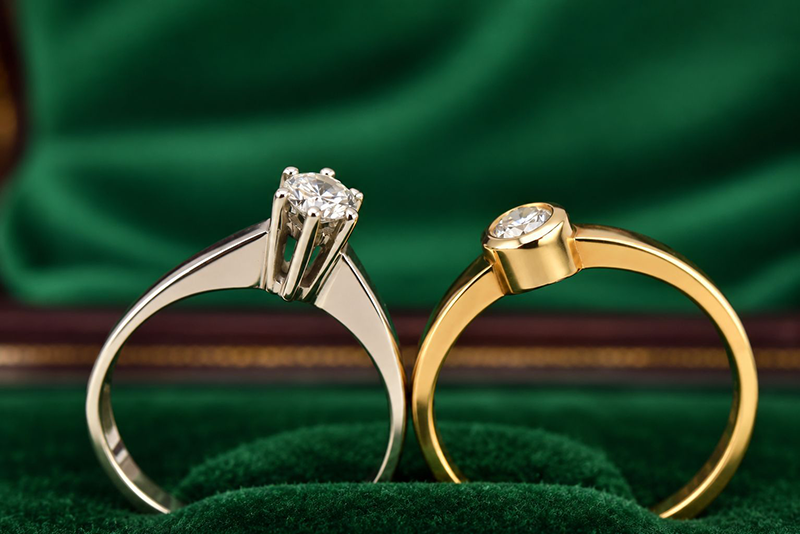
Height, profile and comfort
When it comes to antique or vintage engagement rings, it is definitely worth taking a moment to consider your own daily routine: Do my hands undergo a lot of strain? Do I mainly engage in physical activities? Is the ring at risk of being easily damaged in everyday life?
All these points should be taken into account when choosing an engagement ring. Rings with a high ring head, bold settings, highly exposed or ‘soft’ gemstones, or very thin or heavily set bands may look impressive, but they are highly susceptible to damage and require frequent repairs.
Important: A ring is an everyday item. Nevertheless, certain rules should be followed to ensure you can enjoy your piece of jewellery for many years to come. Please therefore do not wear your rings whilst playing sport or engaging in other active pursuits and heavy physical labour. It is also advisable to remove rings whilst sleeping and showering, as well as whilst working in certain professions (e.g. medicine, nursing), to avoid damage and the associated costs.
Yellow gold, white gold or platinum?
The choice of precious metal also significantly influences the overall effect of a diamond engagement ring and its durability.
Yellow gold has a warm, classic feel and harmonises beautifully with coloured diamonds. Whilst, not so long ago, people tried to use yellow gold settings to distract from coloured diamonds, warmer diamond colours are now deliberately paired with yellow gold. It is precisely this combination that creates a unique and sophisticated look, which is more in demand today than ever before. Here, too, it is all about the search for something truly distinctive. It is no surprise that coloured historical diamonds are currently enjoying a new heyday.
White gold, on the other hand, creates a cooler, more modern look and combines perfectly with colourless diamonds. However, white gold is usually rhodium-plated to produce a particularly clear, radiant surface finish. This coating can wear off over time and must then be renewed.
Platinum is a wonderful alternative in this regard. This precious metal is naturally ‘white’ and, at the same time, durable. It is therefore ideal for high-quality engagement rings that are worn every day.
However, which option is the right one depends not only on appearance and durability. The personal preferences of the recipient should always be taken into account!
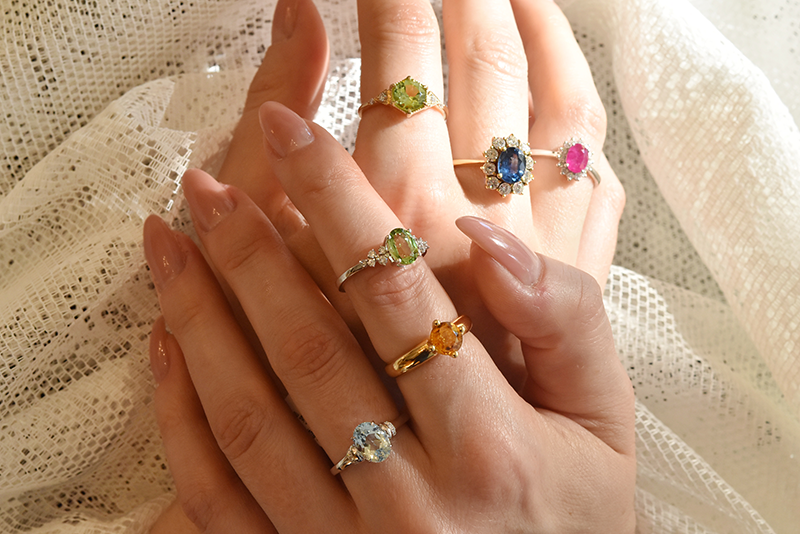
Fancy a splash of colour?
If diamonds aren’t to your future partner’s taste for an engagement ring, don’t be afraid to choose a vintage engagement ring set with coloured gemstones. Here, too, traditional conventions are increasingly giving way, creating scope for personal preferences and individuality.
The best approach here is to find out what the recipient likes. Should it be a stone that reflects her eye colour? Does she perhaps have a favourite gemstone? Or should it be a ring featuring her birthstone?
Our tip: Say goodbye to strict conventions and show that you know your partner, her interests and preferences, so that these are reflected in her very own, personalised engagement ring!
Even within the world of diamonds, colour comes into play: high-profile examples prove that fancy diamonds – that is, coloured diamonds – are also very much in demand!
Why antique engagement rings are back in demand today
An antique or vintage engagement ring embodies something that cannot be recreated: time. Historic goldsmithing, old settings and antique, hand-cut, natural diamonds bear witness to the era in which they were created.
Particularly at a time when virtually any modern jewellery design can be reproduced, when lab-grown diamonds are available in such vast quantities and with such flawlessness that they evoke more boredom than enthusiasm among buyers, and when we are surrounded by constant perfection, this individuality takes on a new significance.
And perhaps this is where the most beautiful connection between a piece of historical jewellery and an engagement lies: a ring that already has a history becomes the starting point for a new one.
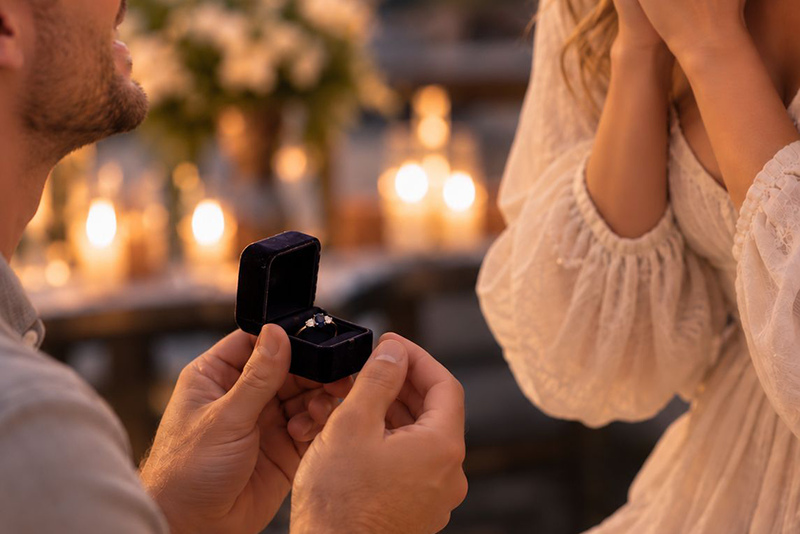
The basics: consultation, ring size and guarantee
At Halsbandaffaire, we’d be delighted to advise you on purchasing an engagement ring. We’ll take plenty of time to answer any questions you may have about the subject and our range of diamond jewellery.
We’re also happy to arrange for our goldsmith to adjust the ring size, so that the piece not only looks beautiful but also fits perfectly right from the start.
Our tip: If you don’t know your future partner’s ring size, why not discreetly bring along a ring she already owns to the consultation? That way, the chosen engagement ring can be adjusted in advance and presented in the correct size straight away!
Should any problems arise, we are of course here to help in such cases too. Under our 2-year warranty, we’ll take care of any issues relating to your engagement ring.