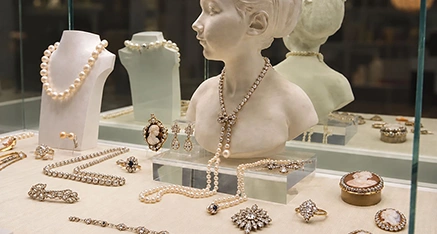
Alongside gemstones and pearls, coral has been an important component of jewellery-making for thousands of years and, due to its unique colour intensity, has also been used in royal regalia and liturgical objects.
However, as there is not just one type of coral, we would like to explain here the key differences between red coral, angel skin coral and foam coral – always with a focus on quality, structure and jewellery craftsmanship.
What exactly is coral?
Coral is an organic material created by colony-forming marine animals known as coral polyps. Certain species of coral develop a solid calcareous skeleton over many years, which, once professionally prepared, can be further processed into jewellery.
This natural formation process explains why corals have a unique natural structure. Depending on the species, growth and quality, colour, density, pattern and surface texture can vary significantly. All corals are given their lustre through professional polishing.
Various types of coral are recognised in the jewellery trade. Red coral, angel skin coral and foam coral are typical and widely available.
Red coral – intense, classic and expressive
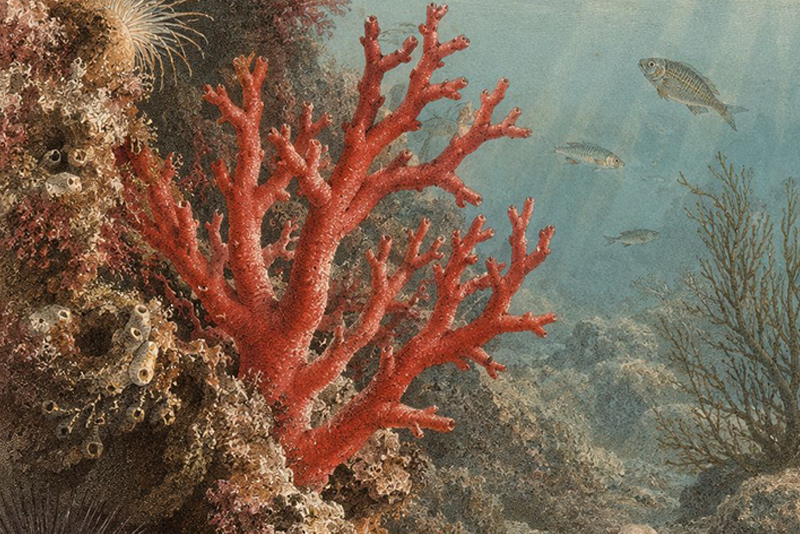
Owing to its rich colour, red Mediterranean coral (Corallium rubrum) is particularly popular in jewellery. Its natural colour spectrum ranges from pale pink (very rare) through orange-red to an intense dark red.
Traditionally, Italian precious coral is either crafted into jewellery as naturally formed branches or strung as beads or ‘olives’ to form necklaces. Pendants and rings are usually adorned with coral in the form of boutons, cabochons or cameos.
Visually, red coral undoubtedly makes a strong impression: its warm, intense colour transforms even simply designed pieces of jewellery into striking eye-catchers. When combined with yellow gold, it creates a warm, classically elegant look.
Silver, white gold or platinum, on the other hand, create a stronger contrast and allow the coral to shine particularly beautifully.
Angel skin coral – delicate shades of rosé and salmon
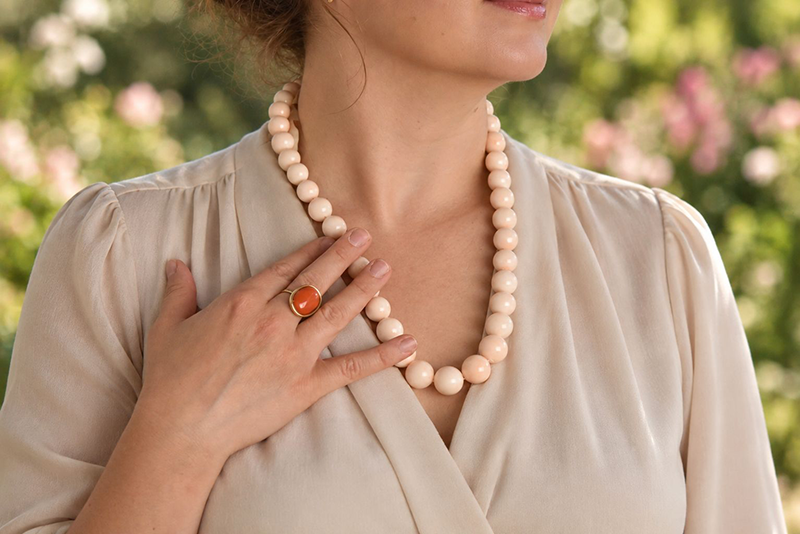
Angel skin coral differs from Italian precious coral both in its origins in the Pacific and in its particularly delicate colouring. Its evocative name refers to the white base tone, which is interspersed with a delicate rosé-coloured pattern and resembles the pale red cheeks of an angel.
It is precisely this subtle colour palette that makes angel skin coral so popular amongst jewellery lovers. Characteristic features include pastel shades of pink, salmon and delicate peach.
Compared to deep red coral, jewellery featuring angel skin coral has a more understated appearance and can therefore be combined in a variety of ways. It has a particularly elegant look and is versatile to wear, as it flatters both very fair and darker skin tones.
Angel skin coral is usually combined with rose or white gold, silver or platinum to create a cool, sophisticated look.
Foam coral – distinctive structure and unique pattern
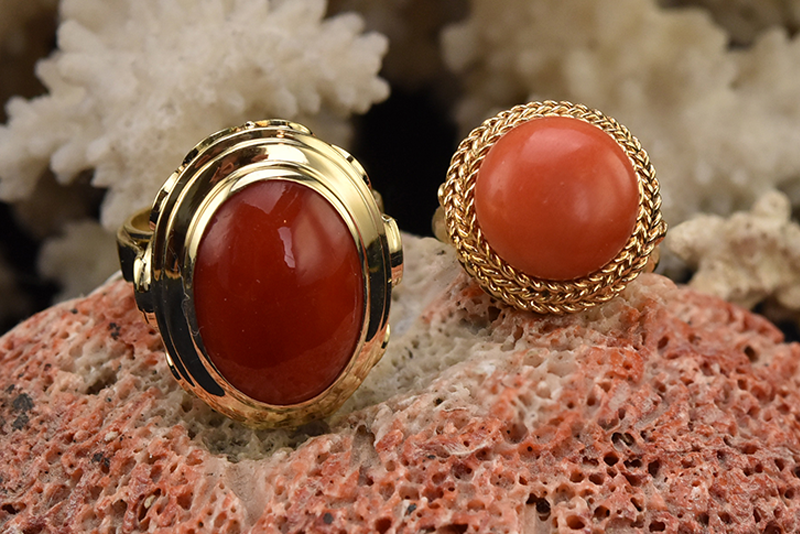
Foam coral – also known as root coral – is particularly striking due to its characteristic structure: it has a porous, finely textured or sponge-like surface and comes in a range of colours from muted reds to light natural tones.
Once ground and polished, foam coral creates an intriguing contrast between smooth surfaces and the underlying structures that become visible.
It is a comparatively affordable type of coral and is therefore often set in silver. So, anyone who enjoys wearing coral jewellery but doesn’t want to spend a fortune can create some very beautiful accents with foam coral.
A comparison of coral types
The key differences between the types of coral described above can be summarised at a glance:
| Red Coral | Angel Skin Coral | Foam Coral | |
| Colour | Red to orange-red, sometimes deep red | Delicate shades of rose, salmon and peach | Muted reds and light natural shades |
| Structure | Generally uniform in texture and colour; may exhibit natural growth characteristics and colour variations | Visible, delicate natural colour patterns and shades | More structured, spongy, porous, with visible structures and patterns |
| Effect |
Intense, bold, expressive and classic Often combined with yellow-gold |
Visible, delicate natural colour textures and shades | More structured, spongy, porous, with visible structures and patterns |
Treatments and Imitations
When buying coral jewellery, there are a few points you should bear in mind, as, in addition to natural coral, dyed, treated, reconstructed or imitation materials are often available on the market.
Visually, such materials can sometimes be difficult to distinguish. When assessing a piece of jewellery, it is therefore important to have a precise description of the material, a reliable statement of origin and an expert evaluation by an experienced dealer or gemmologist.
Furthermore, the trade in coral is strictly regulated and subject to stringent species protection regulations. You should therefore generally ensure that the seller is reputable.
Whilst strict trade bans do not apply to antique coral jewellery, it is still important to ensure the authenticity of the pieces.
You will therefore, of course, find only thoroughly examined coral in the Halsbandaffaire range, which has been assessed in advance by our experts, gemmologists and appraisers.
Caring for coral jewellery correctly
Coral is an organic material and is therefore quite delicate. We have already summarised how to care for and store your coral jewellery correctly in our article ‘How to care for coral jewellery correctly’.