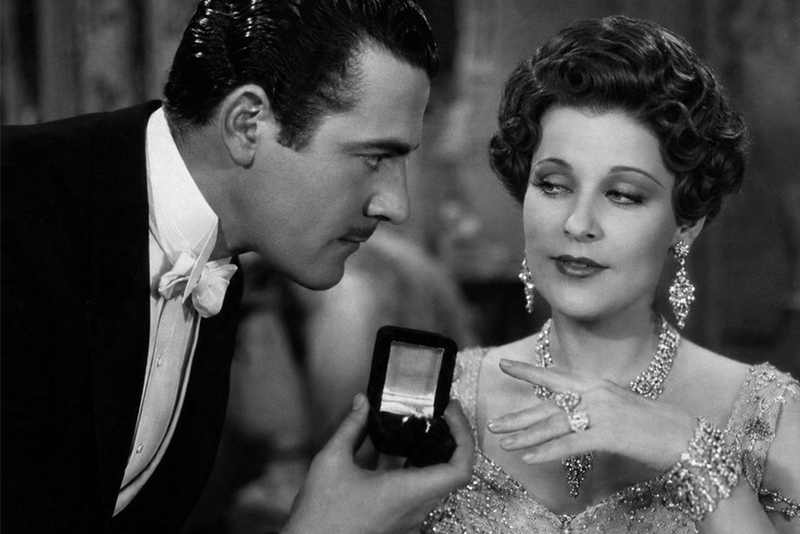
Diamonds are regarded as a symbol of exclusivity and wealth. However, if we look back in time, diamonds were attributed with significance far beyond their material value. They were a symbol of strength and power. And even today, we associate not only luxury with this sparkling mineral, but also love and consistency.
Find out how this came about and what cultural significance diamonds held in different eras in our guide.
“The Indomitable” – Ancient roots and etymology of the diamond
The extraordinary hardness of diamonds was recognised early on, which is why the mineral was referred to in Ancient Greek as “adamas”, a term that can be translated as “indomitable” or “invincible”. The linguistic evolution of the root word led via the terms Adamant through Demant to the modern word diamond.
Initially, however, this term was used to refer to particularly hard materials in general (such as iron) and was only associated with diamonds by Pliny and Theophrastus, whose physical properties seemed to confirm this attribution in a special way.
Due to the mineral’s high light transmission and refraction, its distinctive crystalline form and its rarity, people quickly began to attribute magical powers to it and to use it as a talisman.
This laid the foundation for a symbolism surrounding the diamond that was to accompany the stone for centuries and, time and again, even during wars and conflicts, made it a symbol of power and protection.
Early diamond trade: rough diamonds in India and Rome
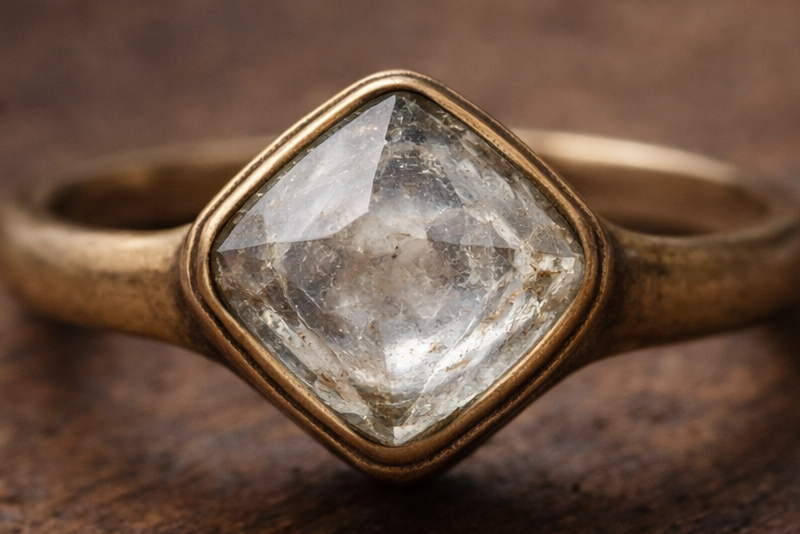
The oldest diamond finds date back to the 4th millennium BC and originate from India, where the stone was revered “as the greatest of all earthly and divine treasures”. A lively trade quickly developed, in which differences in quality were also taken into account. Thus, large and clear rough diamonds in their natural octahedral form were particularly highly valued and regarded by rulers, kings and wealthy merchants as symbols of prestige and bringers of salvation, for they were believed to protect the wearer from, amongst other things, predators, theft or natural disasters.
In addition to using diamonds as tools, there was also a desire to follow the Indian practice in ancient Rome, where emperors and the upper classes likewise sought to adorn themselves with rough diamonds.
What was interesting, however, was that the stones arriving in Rome via extensive trade routes did not come close to the quality of the Indian specimens. Indian traders supplied Europe solely with “second-grade goods”, though this did not seem to bother the Romans in the slightest. Knowledge of diamonds, myths from the Far East and the allure of these precious stones were already so great in ancient Rome that even small and inferior specimens were prized and set in high-quality rings in order to benefit from their miraculous and healing properties and to proclaim one’s status.
With the fall of the Roman Empire, the diamond initially disappeared almost entirely from European jewellery production.
Diamonds in the Middle Ages
Several centuries were to pass during which the diamond was primarily used as a tool or protective stone and existed solely as a so-called pointed stone (polished rough crystal), as it was simply impossible to work the material due to its extreme hardness.
It was not until the 13th century that the first methods were developed to give pointed stones a ‘new’ shape. To achieve this, a point was ground down, resulting in the first table cuts, which already bore a rudimentary resemblance to more modern shapes.
The Italian port city of Venice developed, by the 14th century, into one of the first centres of the diamond trade and cutting, as it had by then been discovered that diamonds could be worked using diamond dust – consisting of low-grade, ground-up diamonds. This technique was increasingly refined through exchange and trade with Asia and the Orient.
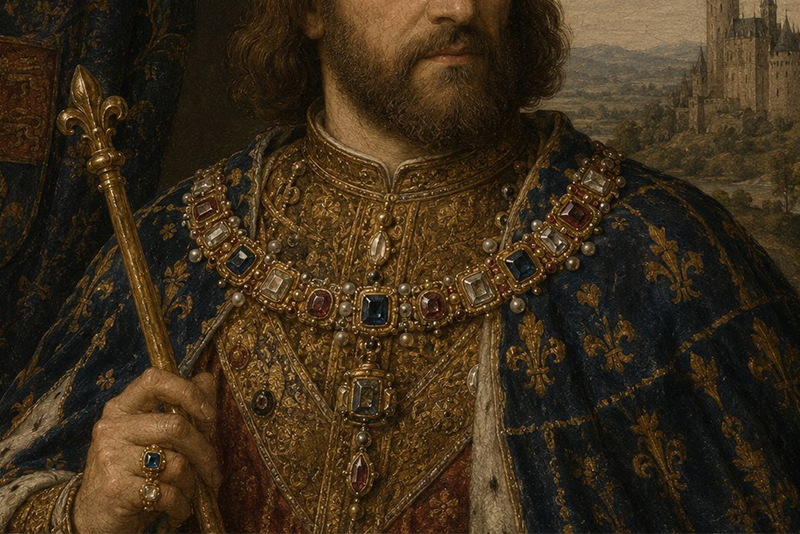
At that time, diamonds were, of course, exclusively found at royal courts and amongst the nobility. However, it was not only jewellery that was set with diamonds, but also royal weapons and armour. Thus, the symbolism of the diamond continued to be used as a sign of invincibility and strength.
Courts, the Church and Politics – A Sparkling Struggle for Status and Power
This symbolic significance did not, of course, arise in isolation, but was deliberately shaped by institutions of power. At the European courts, from the Renaissance onwards, the diamond became a favoured medium for the display of wealth and authority. In crowns, sceptres and orders, it served to make political power both visible and tangible.
The Church also drew upon the evocative power of diamonds by incorporating them into liturgical objects and insignia, where their play of light could be interpreted as a reference to the divine. The diamond’s ability to be penetrated by light almost unimpeded and to reflect it back in sparkling reflections was understood as a visual counterpart to moral and spiritual clarity.
In the wake of global trade networks and colonial expansion, the diamond eventually also acquired a geopolitical dimension: access to mines and trade routes became a decisive factor in economic and political power. Thus, throughout the history of the diamond, its aesthetic impact has been inextricably linked to issues of dominion and control.
Power vs. Love – The Changing Significance of Diamonds
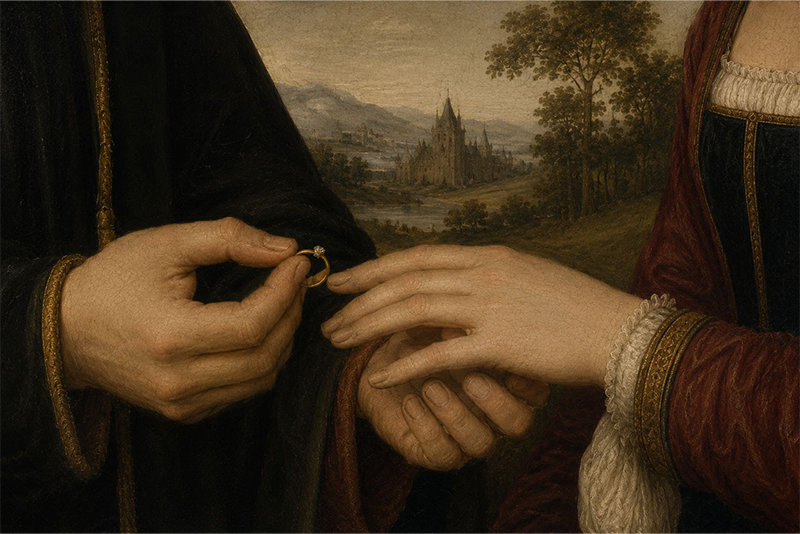
The image of the diamond gradually began to change from the 15th century onwards. The catalyst for this was Archduke Maximilian of Austria, who presented his future wife with a diamond ring upon their engagement. This gradually developed into a romantic custom that elevated the diamond from a status symbol to a symbol of love.
Engagement rings were, admittedly, already well known by then, but they were originally made primarily from iron, which was intended to emphasise the strength and eternity of the romantic bond.
In the 18th and 19th centuries, however, the diamond – as the hardest known mineral – took on this role and, owing to its physical indestructibility, now metaphorically represented the permanence of human bonds – a shift in meaning that was underpinned not least by social practices such as the culture of engagement.
It was certainly more elegant than iron, for diamond cutting had by then made considerable progress: pointed and table cuts were largely a thing of the past, as it was now possible to cleave and facet diamonds. This led to the emergence of rose and single cuts in the 17th century, as well as the Mazarin and Peruzzi cuts, which in turn paved the way for the Old Mine Cut and the Old European Cut in the 19th century.
The diamond was now no longer merely a symbol of strength; instead, its aesthetic qualities came to the fore: The play of light was deliberately designed and associated with notions of grace and emotion.
The diamond’s media breakthrough
The 20th century initially marked the transition to an increasingly rationalised approach to diamond cutting, in which the optical properties of the stone were specifically optimised. This development culminated in the modern brilliant cut, whose mathematically calculated facet pattern produces maximum light reflection and thus embodies the ideal of perfection and radiant intensity.
Instead of the court and the church, it was now primarily the media that spun myths around diamonds. Literature, magazines and, later, film and television attributed significance to diamonds, portraying the gemstone as an object of desire, luxury and emotional appeal.
The advertising strategy of the world’s largest diamond company, De Beers, had a particularly lasting impact here. The company was founded in South Africa in 1888 and soon established a monopoly there, which eventually expanded globally as the company knew how to artificially create a shortage of its product. Demand for diamonds, which this approach had turned into an exclusive commodity, remained correspondingly high until the Great Depression of the 1930s, when sales of luxury goods slumped sharply.
“A diamond is forever”
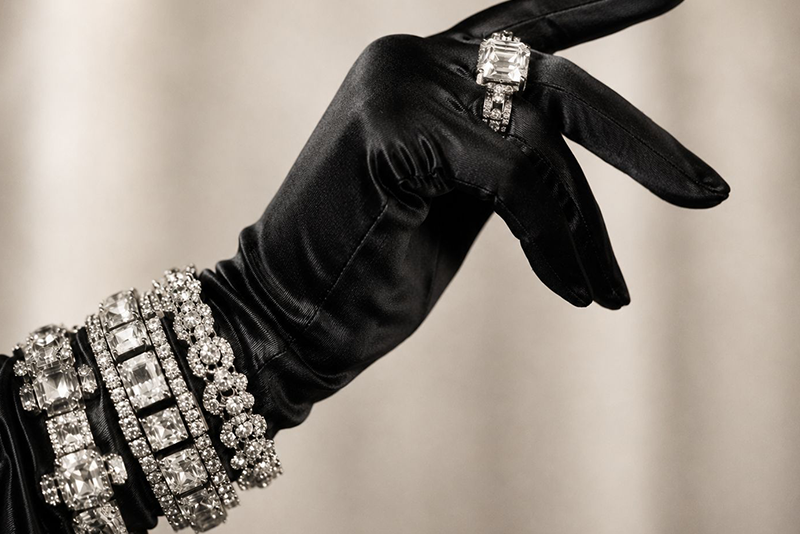
The company’s turnaround began in 1947, when copywriter Frances Gerety pulled off a masterstroke that would continue to have an impact for decades to come: she coined the marketing slogan “a diamond is forever”, which made diamonds the ultimate symbol of everlasting, romantic love and thus created a targeted cultural narrative.
De Beers also supplied stars and starlets with diamonds to further popularise this narrative. An iconic example of this is the 1953 film "Gentlemen prefer Blondes", in which Marilyn Monroe sang of diamonds as “a girl’s best friend” and elevated them to an indispensable attribute of glamour and female self-assertion.
In “Breakfast at Tiffany’s”, Audrey Hepburn turned the famous New York jeweller and its luxuriously glittering window display into a place of longing, and in 1971, James Bond also knew that “Diamonds are Forever" when, in the film of the same name, he was hot on the trail of diamond smugglers. The accompanying theme song – sung by Shirley Bassey – became one of the most iconic pieces of music in the entire James Bond film series.
Articles, photos and advertisements in the print media of the time did the rest to establish diamonds as a symbol of love in society and to cement them as a must-have for engagements in the collective consciousness of the Western world.
Diamond jewellery today
In an age of unrestricted individual self-expression and self-promotion via social media, personality is once again coming to the fore in the jewellery industry and is beginning to replace the dogma shaped by De Beers over decades. Diamond jewellery and engagement rings are now chosen according to personal preferences, one’s own sense of style and individual aesthetics. It no longer has to be the classic ring with a brilliant-cut solitaire.
With the emergence of lab-grown diamonds , the mineral has also become a mass-market commodity in recent years. The fall in the price of both synthetic and natural diamonds is a logical consequence of this, and is also rooted in the loss of exclusivity that De Beers was so skilful at exploiting in the 20th century. Consequently, the parent company Anglo American announced as early as 2024 its plans to sell De Beers.
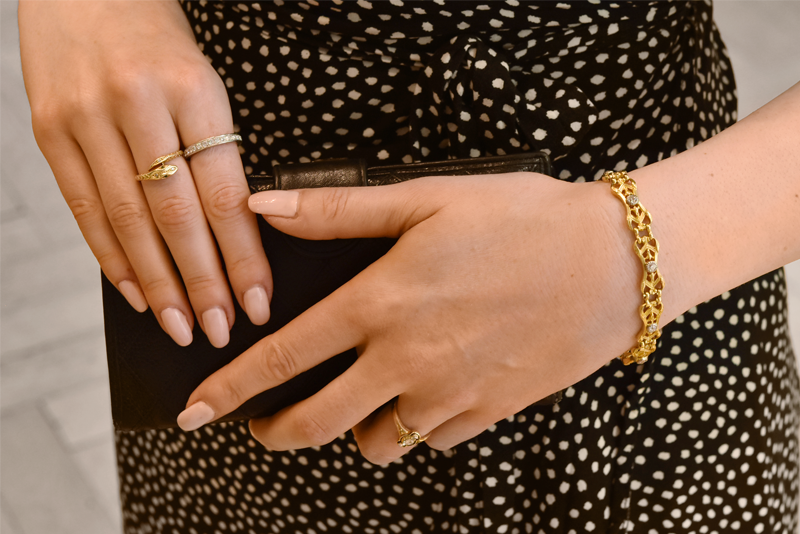
As a counter-trend to the classic diamond ring, there is currently a deliberate shift towards unique pieces. One of a kind antique jewellery, coloured gemstones in engagement rings or even the romantic aesthetic of historic diamond cuts and tinted stones can just as effectively symbolise everlasting love. Role models for this include pop stars such as Taylor Swift, whose engagement ring is set with a vintage Old Mine Cut diamond and draws stylistically on antique designs.
The search for diamond jewellery with meaning
The significance of diamonds is therefore no longer based solely on their physical properties. Rather, the gem is the result of a continuous process of cultural negotiation in which language, power, aesthetics and the media intertwine. What began in the history of diamonds as ‘adamas’ has evolved into a multi-layered symbol that encompasses strength, purity and fidelity as well as wealth, desire and social status.
The intertwining of diamonds with their own history is also a key concern for us at Halsbandaffaire. Our range combines diamond jewellery spanning three centuries with contemporary small-batch collections. Passing on living history and offering a glimpse into the past through authentic vintage and antique jewellery is just as important to us as keeping up with modern trends. Because diamond jewellery is never merely a luxury item of exceptional material quality, but a reflection of cultural ideas that have become associated with it over the course of history.

