„Diamonds are forever“, as James Bond and many others knew back in the 1950s. Anyone who buys diamond jewellery is therefore choosing far more than just a gemstone: the cut, material, era and setting all shape the character and impact of the jewel.
This guide shows you what really matters when buying diamond jewellery – and why not every diamond should be judged by the same standards.
Historical context: from the rose cut to the brilliant cut
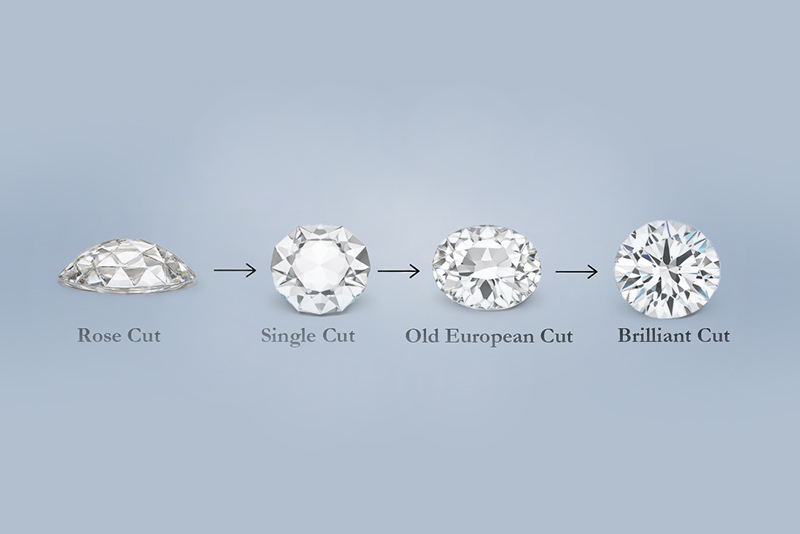
A diamond’s cut defines both its play of light and its historical character. A look at the development of the most important diamond cuts helps you to better understand modern and historical diamond jewellery before making a purchase.
Rose cut
The so-called diamond rose is one of the early diamond cuts and was developed in the 17th century. It is characterised by its single-sided, dome-shaped faceting with a flat, unfaceted underside.
Single cut
The single cut is considered a precursor to the Old European Cut; it is characterised by its mostly round shape with eight facets each in the upper and lower sections, resulting in a total of 17 facets including the table.
Old European Cut
The Old European Cut was developed towards the end of the 19th century. Old European Cuts are diamonds with an upper section (crown), girdle (a sort of band around the centre of the stone) and pavilion. The crown features a larger, central table facet, through which the flattened tip (culet) of the diamond is often clearly visible.
Old European Cuts are not yet as well-proportioned as the later brilliant cut and are often characterised by slightly irregular shapes and a high crown. As a result, they usually have more fire, but less brilliance than their modern successors.
Modern brilliant cut
A modern brilliant is clearly defined by a round basic shape and a total of at least 57 facets. The Belgian mathematician and gemmologist Marcel Tolkowsky, who developed the brilliant cut in 1919, is regarded as the inventor of this system. His aim was to achieve the perfect proportions for the gemstone and to achieve total internal reflection of the incident light, thereby achieving maximum brilliance.
From the 1930s onwards, the brilliant cut became firmly established in jewellery.
Materials and quality knowledge: Understanding the 4Cs
Whilst historical cuts should primarily be viewed in the context of the era in which they were created, a systematic evaluation method has become established for modern diamonds.
The concept of the so-called 4 Cs, developed in the mid-20th century by the Gemological Institute of America (GIA) in the mid-20th century offers you an objective system for assessing the quality of a diamond. When buying diamond jewellery, you should therefore always bear these four criteria in mind, as two diamonds of the same size are not automatically worth the same.
Carat
The carat weight indicates the weight of a diamond. One carat is equivalent to 0.2 grams. The more a diamond weighs, the more expensive it is. However, it is extremely important to understand that carat weight and price do not increase in direct proportion to one another!
Clarity
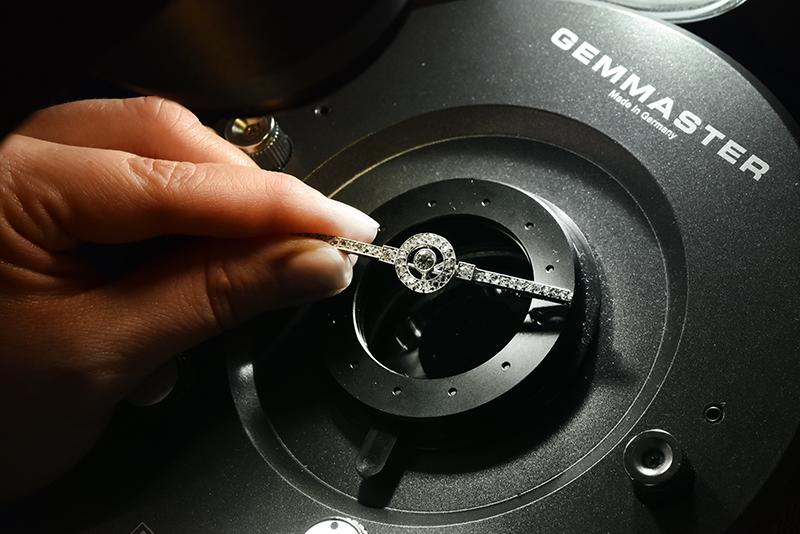
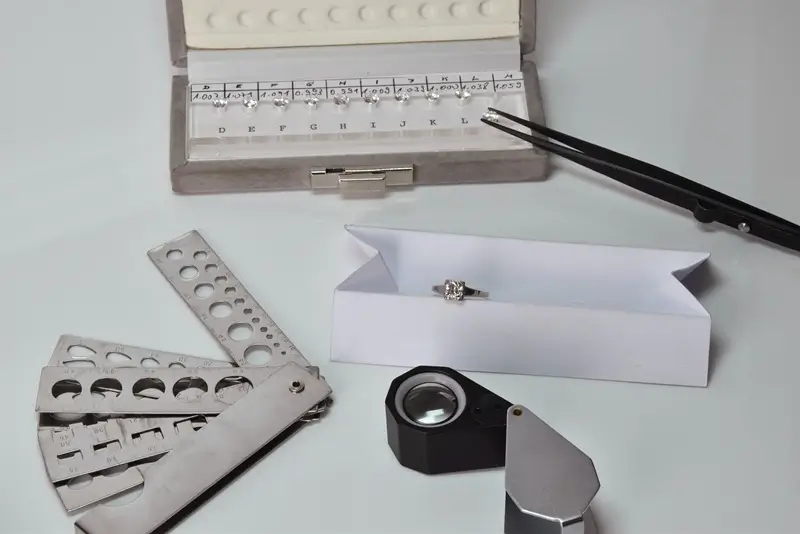
To determine a diamond’s clarity, it is examined under tenfold magnification using a loupe. The vast majority of diamonds contain inclusions, which are graded on the GIA scale depending on their size, position within the stone and intensity. This ranges from flawless to significant inclusions (Piqué) . The latter can also be seen with the naked eye.
Colour
When it comes to a diamond’s colour, the rule is: the more colourless a diamond, the higher its value. The GIA scale starts at D for colourless diamonds and ends at Z for yellowish stones. Diamonds with intense colours such as brown, blue or pink do not fall into this grading category and are traded as fancy diamonds.
Cut
A good cut is crucial for a diamond’s brilliance, as this is the only way its dispersion – the so-called “fire” – reaches its full potential. This is an optical property of the mineral whereby it refracts the incident light into its spectral colours and reflects them in a rainbow-like pattern. If the cut is poor, e.g. too flat or too pointed, this effect is lost. Parameters such as symmetry and polish are also taken into account here.
What the 4Cs achieve – and where their limitations lie
Evaluating a diamond using the 4Cs makes it comparable and can make the purchase easier. However, other quality characteristics such as fluorescence, shape or the historical context of its origin can influence the price and also the character of the stone and should be taken into account when purchasing.
Expert tip: The 4Cs apply primarily to modern brilliant-cut diamonds. Historical diamond jewellery should always be viewed and purchased within the context of its origin. In past centuries, diamonds were traded almost exclusively by weight (carat). For a long time, maximising volume retention after cutting was therefore more important than, for example, colour, clarity and brilliance.
Also important: There are often quantum leaps between certain carat weights. Consequently, particularly popular diamond sizes such as half-carats and one-carats are priced significantly higher than diamonds weighing, for example 0.45 carats or 0.9 carats. These differences are barely perceptible to the naked eye, but are clearly noticeable in the price.
How to read and check certificates correctly
Anyone wishing to buy diamond jewellery is usually presented with certificates and test reports . However, their significance always depends on whether a loose diamond has been graded or whether the diamonds are set in a piece of antique jewellery.
The Gemological Institute of America (GIA) is one of several institutes worldwide that carry out objective and scientifically sound grading of diamonds. GIA certificates are regarded as the gold standard of diamond grading. Every graded (loose!) diamond is assigned an individual report number, which can be used to access and verify the gemstone online at any time.
Recently, the GIA has revised its grading practices for lab-grown diamonds – that is, diamonds created in a laboratory. These now form a separate category and are only given a summary classification of “Premium” and “Standard”. In future, a GIA certificate adhering to the 4Cs will only be issued for natural diamonds.
Expert tip: Natural and lab-grown diamonds are identical in their optical and chemical properties!
Conventional gemmological examination methods are therefore no longer sufficient to make a definitive determination. Special machines or instruments are required for this purpose. If you are told otherwise during a sales conversation, you should perhaps refrain from making a purchase at this point.
Buying modern vs. historical diamond jewellery
In the Halsbandaffaire range, you will find both historical and modern diamond jewellery.
All diamonds are graded by us (in their settings) according to the 4Cs and examined with the utmost care using microscopes, loupes and colour comparison sets.
Our promise: At Halsbandaffaire, you only buy pieces of jewellery with natural diamonds! Even in our modern range, we do not use lab-grown diamonds. This stance is important to us and represents a conscious decision in favour of transparency and material authenticity.
What types of diamond settings are there?
A diamond’s setting not only influences its appearance, but also its suitability for everyday wear and durability. Although diamonds are considered the hardest natural material in the world, they possess the property of fissility. This is the only way they can be properly worked.
However, this cleavability can make the mineral vulnerable to damage under adverse conditions. You should therefore treat your diamond jewellery with care and also pay attention to the gemstone’s setting when purchasing jewellery.
Depending on how you wear it, your style and the desired effect, different types of settings may be suitable.
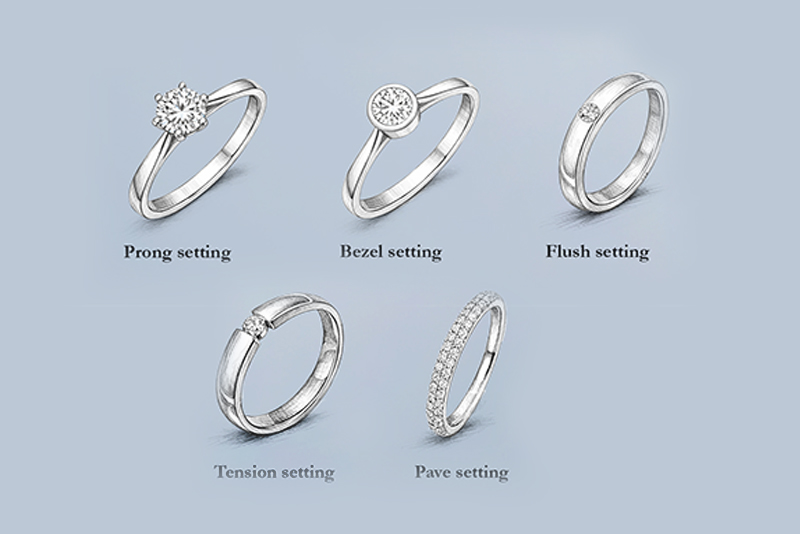
Prong setting
In this setting, the diamond is highly exposed and is held in place only by small prongs, known as claws, to showcase its full brilliance. For this reason, the prong setting is an absolutely classic and very popular setting style for diamonds, particularly for engagement rings.
Bezel setting
In this style, the gemstone is completely enclosed by a band of metal. The bezel setting is therefore particularly secure, as it protects the stone from shocks and other impacts. If you are buying diamond jewellery that is to be worn frequently or even daily, a bezel setting is highly beneficial. The only drawback here is the reduced light exposure.
Flush setting
A particularly secure type of setting, as the stone is set directly into the material. The edge of the surrounding metal is gently ‘rubbed’ over the diamond, so that the metal and stone form a single unit and the actual setting is virtually invisible.
Tension setting
Here, the diamond is set using tension, so that it appears to float within the piece of jewellery. In a ring, for example, the stone is clamped directly into the ring shank and held in place solely by the pressure of the shank itself. The advantage of the clamp setting is, once again, the maximum light penetration.
However, this is a very insecure setting, which carries a high risk of loss or damage.
Pavé setting
The term comes from French and means something like “paved”. This means that small diamonds are set close together and held in place by tiny prongs. This setting style makes a striking impression, as it allows even larger areas of jewellery to be set with diamonds, creating a particularly glamorous look.
Buying authentic diamond jewellery: What do the hallmarks mean?
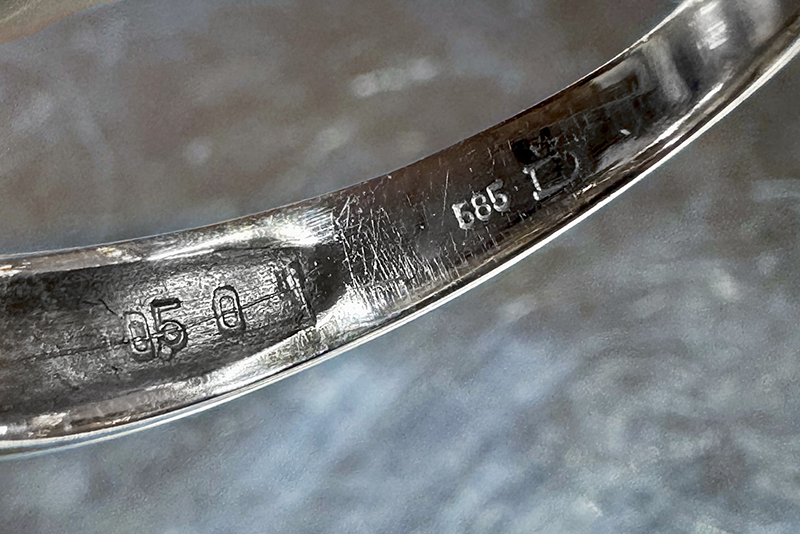
Jewellery pieces are hallmarked – i.e. stamped – to provide information about, amongst other things, their respective alloy, the place of origin, their manufacturer or the goldsmith who crafted them. However, as there were no standardised regulations for hallmarking for centuries, these markings can vary greatly.
Even unmarked pieces of jewellery are not uncommon. In Germany, it was not until 1884 that the Hallmarking Act introduced a standardised regulation, which became binding from that point onwards. However, there is still no obligation to hallmark in Germany. Consequently, there are numerous high-quality pieces of jewellery without any hallmarks.
Furthermore, different countries use different hallmarks to this day. Often, this can even be used to determine the exact year of manufacture of the item.
In German-speaking countries, the gold alloys 333, 585 and 750 are commonly used. These numbers indicate the fine gold content in thousandths: a piece of jewellery marked ‘750’ therefore consists of 75 per cent fine gold.
24-carat gold (999 fine gold) is generally found only in coins and bars.
Choosing diamond jewellery with expertise
Deciding on the “right” diamond jewellery requires knowledge, experience and an eye for materials and craftsmanship. However, the investment is well worth it, because when you own a natural diamond, you truly possess a wonder of nature, formed millions of years ago in the depths of the Earth and transformed through masterful craftsmanship into an object that stands for value, durability and exclusivity.
So, discover a carefully curated selection of unique diamond jewellery at Halsbandaffaire and place your trust in our many years of expertise in the jewellery and art trade.
FAQ